GT7 Datalogger
A telemetry datalogger and analysis dashboard for Gran Turismo 7. It captures the PlayStation's live telemetry stream, records every lap, and serves a modern dark-themed web dashboard for live driving, lap comparison, race strategy, and session management.
What it does
GT7 streams encrypted telemetry over UDP at 60 Hz while you drive. GT7 Datalogger:
- Captures that stream — Salsa20 decryption, heartbeat keep-alive, auto-discovery, automatic reconnect.
- Records every lap — 39 columns at 60 Hz including per-wheel slip, per-corner tire temps, suspension travel, g-forces and body slip, plus per-lap aggregates and detected chassis events (lockups, wheelspin, bottoming, kerb strikes).
- Serves a web dashboard — live race readouts, multi-lap analysis with synced cursors and a race line map, session history, and a fully customizable OBS/phone overlay builder.
Everything runs in a single container (or natively on hardware as small as a Raspberry Pi Zero) and is viewed from any browser on your network.
Quick start
GT7_PS_IP=<your playstation ip> docker compose up --build
Open http://localhost:8000 and start driving. No PlayStation handy? Run
GT7_SOURCE=sim docker compose up --build for a fully simulated demo.
→ Full quick-start guide
The views
The web UI's tabs are Live · Analysis · Sessions · Tracks · Survey · Overlays ·
Settings, plus two full-screen pages for a second screen: /dash and /engineer.
-
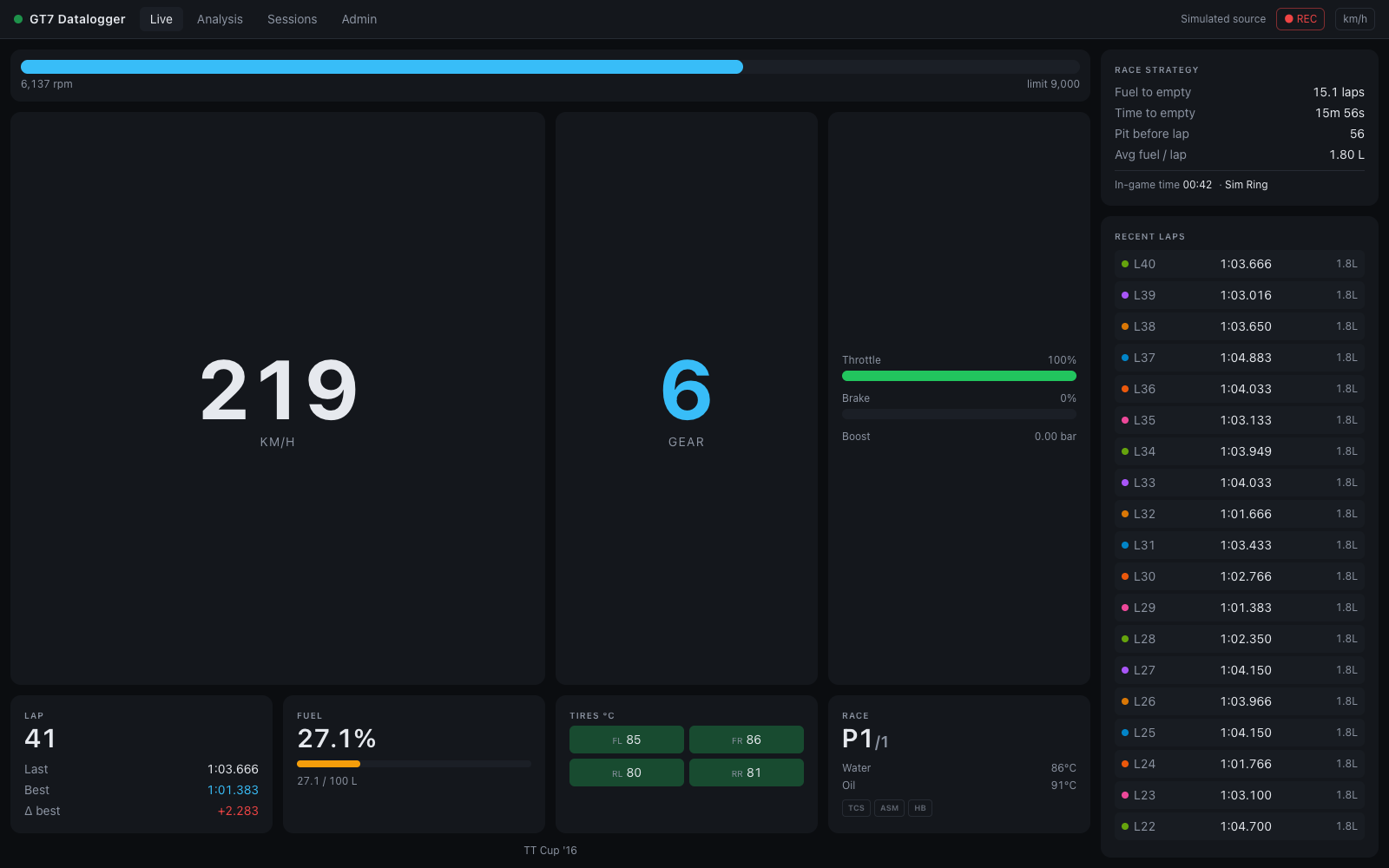
Live view — big race readouts: shift lights, speed, gear, live delta, timing, an input trace, fuel strategy, tires, driver-aid pills, alerts, and a clickable rail of this session's laps.
-
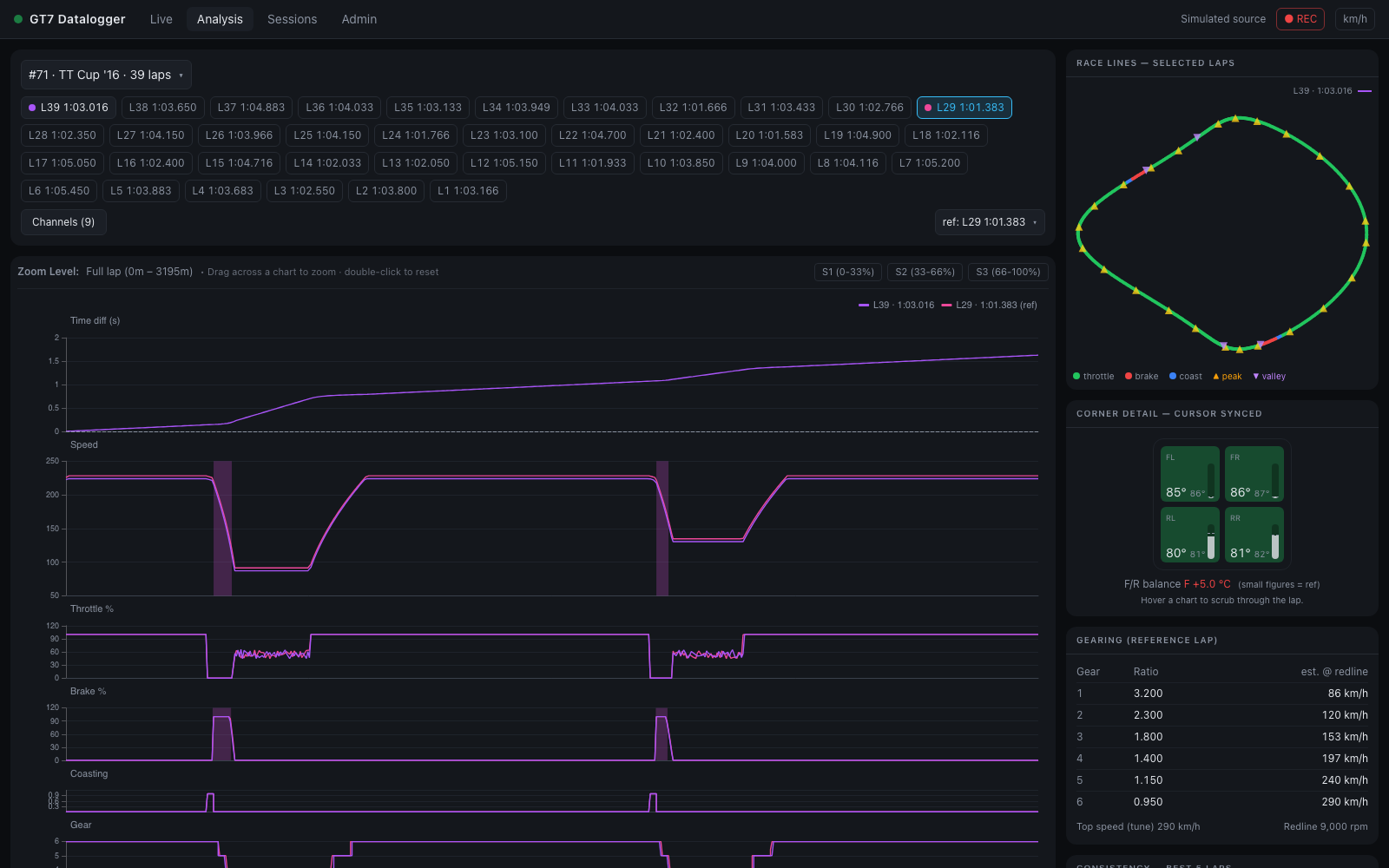
Analysis view — overlay multiple laps against a reference: 31 telemetry channels, time-diff over distance, synced cursors, a lens-coloured race line map that zooms to a corner, a lap strip with sectors, sector times, a corner report card with braking points, stint trend, lap playback, and detected events.
-
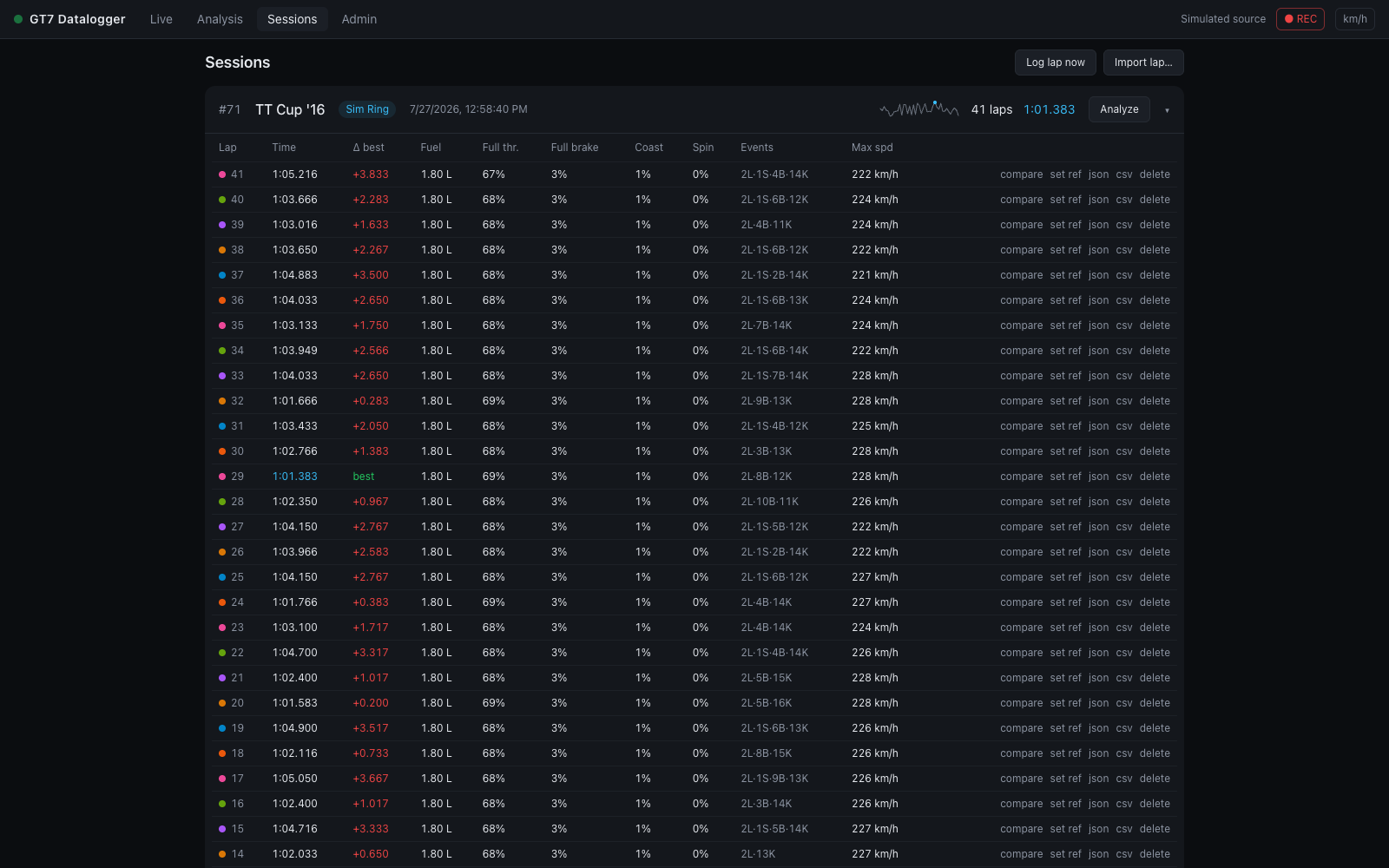
Sessions view — browse history session by session: stats, a lap-time chart and per-lap metrics; export laps as JSON or CSV/MoTeC, import shared laps, and the Bests board.
-
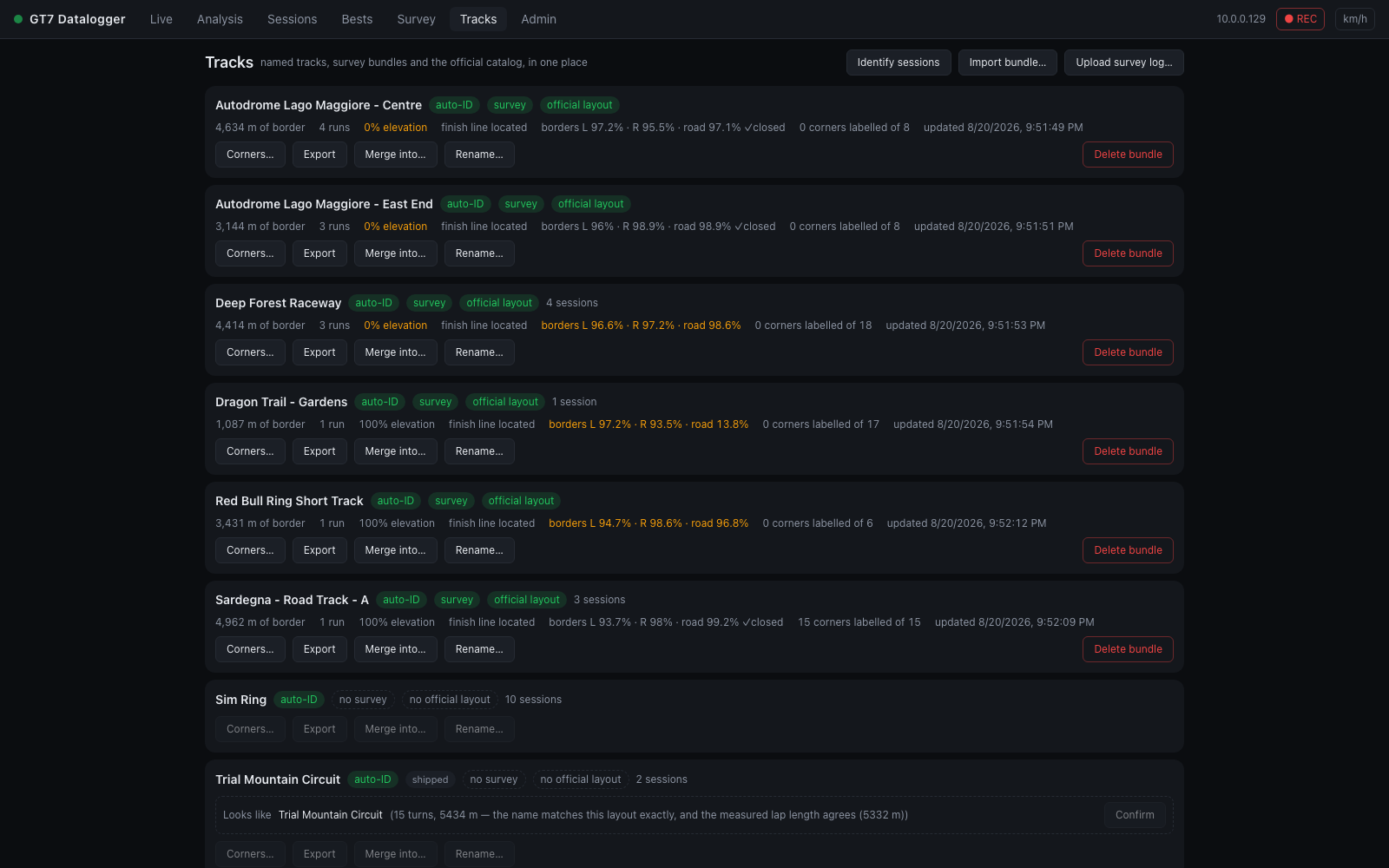
Tracks view — what each circuit has (a name, a survey, an official layout, labelled corners), what is missing, and the fix for each.
-
Overlays & streaming — build a custom overlay for OBS, a phone dashboard, or a pit-wall tablet: place and style widgets on a grid, pick a canvas size, save named layouts.
-
Settings — connection, sync, Race Engineer, notifications, health, logs, access and data, changed at runtime with no restart.
Screenshots
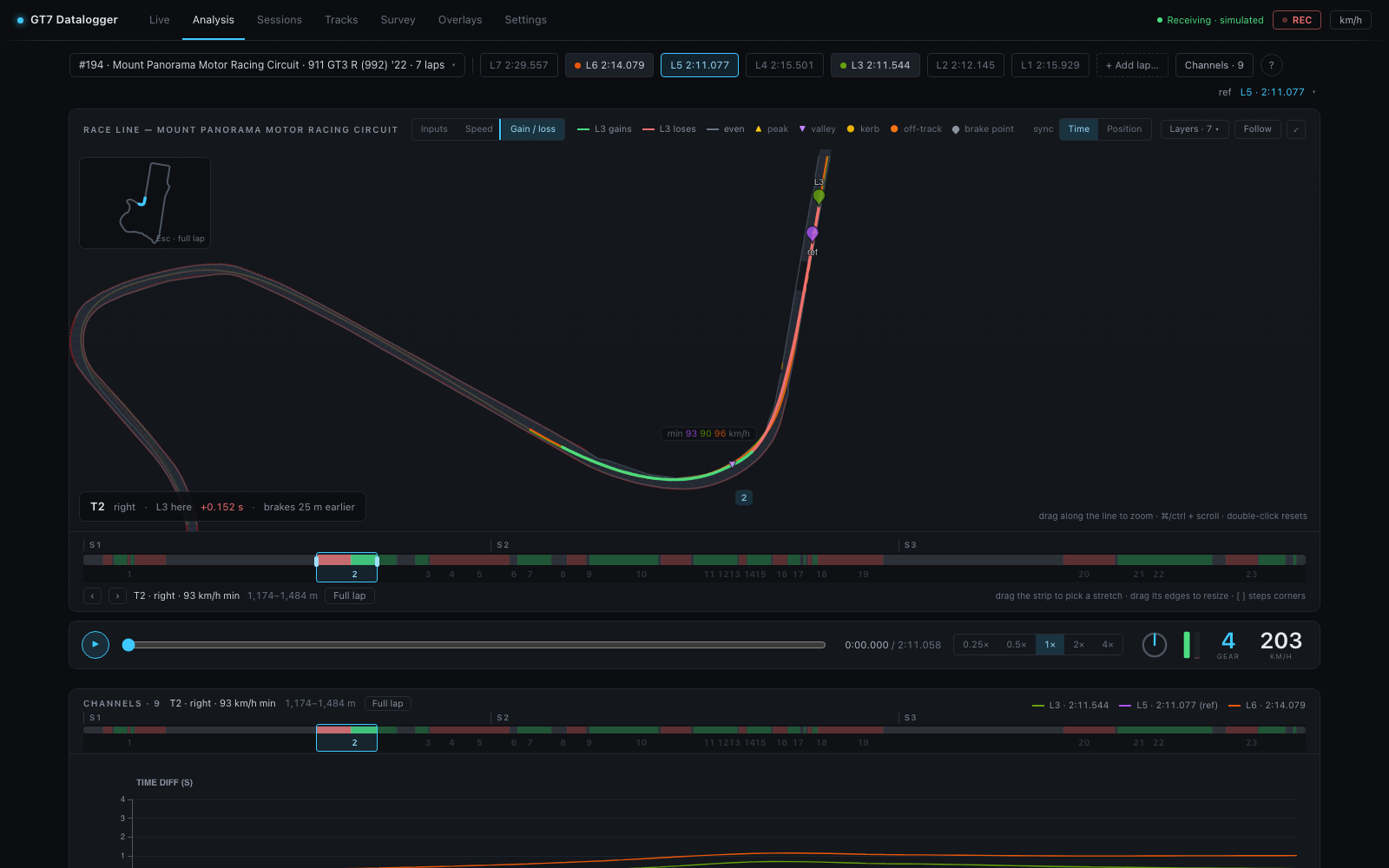
Analysis view zoomed to a corner — the Gain / loss lens, the locator inset, apex badges with each lap's minimum speed, brake-point pins, and the callout:
Live view — race readouts, driver-aid pills, strategy, and the clickable laps rail:
Sessions view — the session list, stat strip, lap-time chart and per-lap metrics
with event counts (2L·1S·4B = lockups · wheelspins · bottoming):
OBS overlay — one of the layouts from the overlay builder, at an exact canvas size:

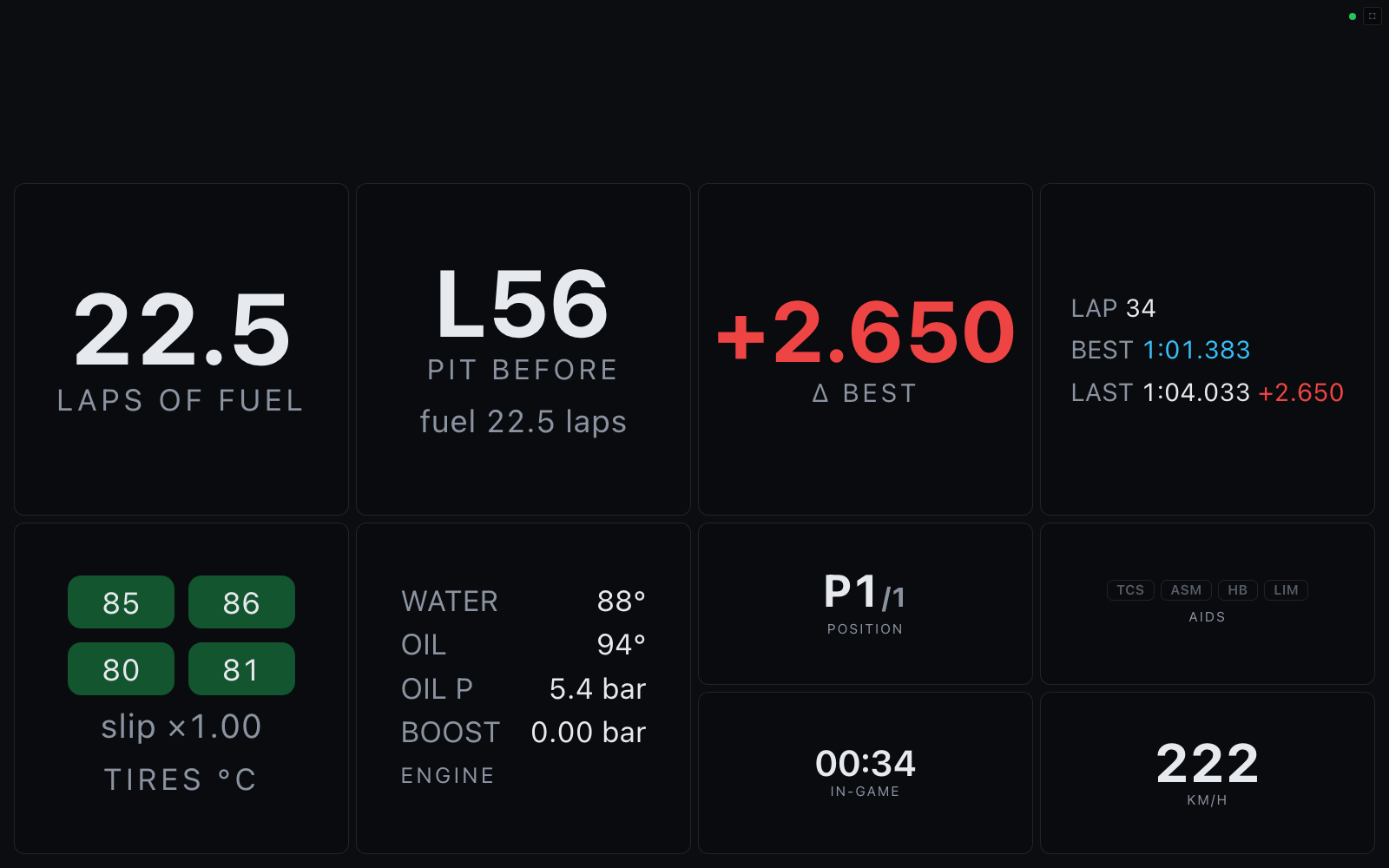
Driver dashboard — the Race engineer preset for a second display during the race:
Tracks view — what is surveyed, what is named, and what the official layout is:
Screenshots were captured against the built-in simulated telemetry source on a scratch database, with the circuits pulled from the shared track repo; the Analysis screenshots show recorded laps at Mount Panorama.
How it works
Curious about the internals? The How it works section explains the machinery in detail:
- Architecture — how capture, processing, storage, and the UI fit together
- Telemetry capture — the GT7 UDP protocol, Salsa20 decryption, and every decoded field
- Lap detection & sessions — how laps are cut from the stream and grouped into sessions
- Derived channels & metrics — the math behind every computed channel and per-lap aggregate
- Chassis event detection — how lockups, wheelspin, bottoming, and kerb strikes are found
- Fuel & race strategy — the live pit-window and fuel-to-empty calculations
Credits & related projects
GT7 Datalogger has full feature parity with snipem/gt7dashboard — the original Python race-telemetry dashboard — plus additional features: the analysis channel picker, Corner Detail widget, chassis event detection, track auto-identification, the overlay builder, and webhook notifications, all rebuilt on a cleaner architecture with a modern UI.
Also see MacManley/gt7-udp, a GT7 UDP telemetry parser for ESP32 / ESP8266 boards and a great reference for the packet format.
The shipped track signatures are built from the circuit captures published by zetetos/gt-telemetry — 84 recorded laps, one per configuration, released under MIT. Their world coordinates are GT7's own, so they need no transform to line up with ours, which is what lets a circuit identify itself on an install where nobody has driven or surveyed anything. Not affiliated; used with attribution.
This project's own track data lives in gt7-datalogger-track-data, separate because it changes every time somebody drives rather than every release.
Licensed under the MIT License.